Dryer Vent Cleaning in Florida
Dryer vent cleaning removes flammable lint and debris from the whole exhaust path of your clothes dryer: the transition hose behind the machine, the duct that runs through the wall or attic, and the hood outside. It is the single most effective way to prevent dryer fires and should be done at least once a year.
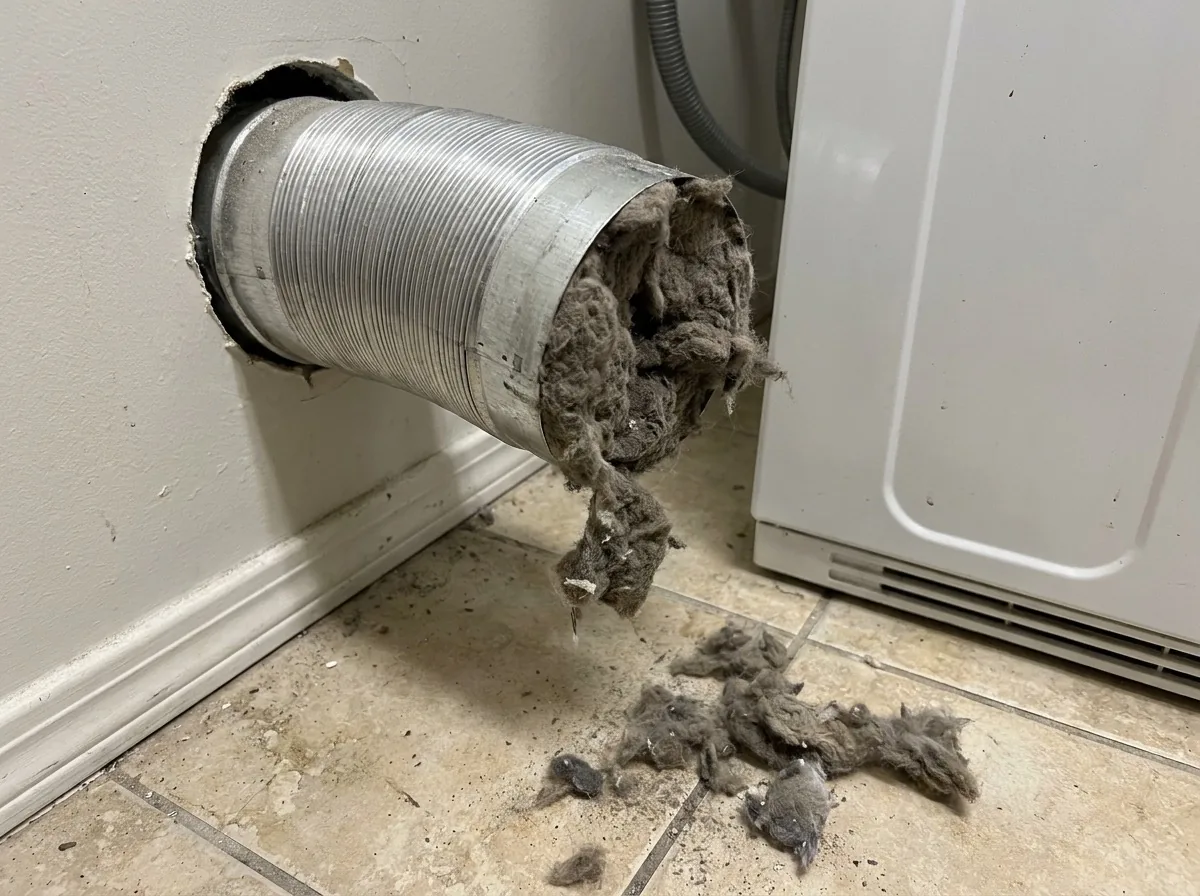
The US Fire Administration puts clothes dryer fires in residential buildings at about 2,900 a year, and names failure to clean as the leading contributing factor at 34 percent of them. Lint is highly flammable, and when it restricts airflow the dryer overheats, a risk most homeowners never see because the buildup is hidden inside the wall or roof run.
Florida homes often have long, twisting vent runs to the roof, which trap lint faster. If your clothes take two cycles to dry, the top of the dryer is hot to the touch, or the laundry room feels humid, your vent is likely restricted.
We disconnect the dryer, run a rotating brush and high-pressure air through the entire run to the exterior termination, clear the outside vent hood, and confirm strong airflow before we finish.
The hose behind the dryer is part of the job, and it is often the worst part of it. That short flexible piece, which the trade calls the transition duct, connects the back of the machine to the vent in the wall. It is the first thing the exhaust reaches after the lint screen, so whatever slips past the screen lands there first, and any kink or sag turns it into a trap. If you searched for dryer hose cleaning, this is that service: the hose, the duct beyond it and the outside hood are cleaned on the same visit, for the same $100 to $200.
Why the hose clogs and crushes. The dryer gets pushed back toward the wall after every move, every repair and every time someone mops behind it, and a hose with nowhere to go folds flat or bends into a tight kink. Extra length gets coiled up behind the machine, and each low loop collects lint and damp air. Hot, humid exhaust in a Florida laundry room leaves that lint slightly tacky, so it clings to the ribs of a corrugated hose instead of blowing through. A crushed hose can be the reason a dryer stops heating partway through a cycle, because the restricted exhaust overheats it and its safety devices cut the heat.
There are three kinds you will find back there. White plastic or vinyl hose should not be on any dryer, because it is not made for the heat, and it is the one we replace as soon as we see it, with your go-ahead. Thin foil accordion hose is the most common: cheap and easy to fit, but its deep ribs catch lint and its wall crushes under almost no pressure. Semi-rigid aluminum holds its shape when the dryer is moved, has shallower ribs, and is the practical choice in most laundry rooms. Rigid metal with fixed elbows is the smoothest of all, and it suits a dryer that is rarely pulled out.
What the code allows behind the dryer is narrow. The building code permits a listed transition duct, meaning one labeled to UL 2158A, as a single length of no more than 8 feet. It has to stay out in the open. It may not pass through a wall, floor or ceiling or be hidden inside one, and it may not stand in for the duct itself. Look for the UL 2158A marking on the hose or its packaging. A hose without it, or one that disappears into the wall, is something we point out on the visit.
Cleaning the hose or replacing it comes down to what it is and what shape it is in. A semi-rigid or rigid transition in good condition is cleaned: disconnected at both ends, brushed and blown out, checked for tears, and refitted with clamps rather than tape. A foil hose that is crushed, torn, stiff with lint or pinched where it meets the wall costs less to replace than to keep fighting, and a plastic one is replaced whatever its condition. Cleaning the hose is included in the price of the visit. If it needs replacing, we show you what we found and give you the price before a new one goes on, and you can say no.
Two minutes when the dryer goes back prevents most of this. Leave enough room behind the machine for the hose to make a gentle curve, use the shortest length that reaches, and if the space is too tight for any curve at all, the fix is a recessed dryer box set into the wall, which is installation work rather than cleaning.
Key benefits
Prevents dryer fires
Removing lint eliminates the leading cause of dryer-related house fires.
Faster drying
Clear airflow means clothes dry in one cycle instead of two, saving time and energy.
Lower bills & longer dryer life
The dryer runs cooler and shorter, reducing wear and electricity or gas use.
Less humidity & mold
Proper venting pushes moist air outside instead of into your laundry room.
The hose behind the dryer, included
The transition hose is disconnected, cleaned and refitted on every visit, because it is the first place lint stops and the piece most likely to be crushed.
A straight answer on the hose
You hear whether yours is plastic, foil, semi-rigid or rigid, whether it carries a UL 2158A listing, and whether it should be cleaned or replaced.
Our process
- Airflow test. We measure exhaust airflow at the vent hood to quantify the restriction.
- Pull the dryer and the hose. The dryer is moved out and the transition hose is disconnected at both ends, cleaned, checked for crushing and tears, and its type and listing noted.
- Brush & air-sweep. A rotating brush and compressed air clear lint along the full run to the exterior.
- Exterior vent clearing. We clean the outside hood and confirm the damper opens freely.
- Reconnect and verify. The hose is clamped back on in a gentle curve, the dryer is set back without crushing it, and a second airflow test confirms the vent is fully clear.
Dryer Vent Cleaning: FAQs
How often should a dryer vent be cleaned?
At least once a year, more often for large households, homes with pets, or long vent runs common in Florida.
What are the signs of a clogged dryer vent?
Longer drying times, a hot dryer or laundry room, a burning smell, and a vent hood flap that no longer opens fully.
Can a clogged dryer vent really cause a fire?
Yes. Lint is highly flammable and restricted airflow makes the dryer overheat; clogged vents cause thousands of house fires every year.
How much does dryer vent cleaning cost in Florida?
Most homes pay $100 to $200, depending on the length and complexity of the vent run.
Do you clean the dryer hose, or just the vent?
Both, on the same visit. The transition hose behind the dryer is disconnected, cleaned and refitted as part of every dryer vent cleaning, and it is included in the $100 to $200 price. Cleaning the wall duct and leaving a hose full of lint behind the machine would leave the first restriction exactly where it was.
Should I clean or replace my dryer hose?
Clean it if it is semi-rigid or rigid metal, holds its shape and has no tears. Replace it if it is plastic or vinyl, if a foil hose is crushed, torn or kinked, if it is longer than 8 feet, or if it runs into a wall or ceiling. We tell you which one you have and quote any replacement before doing it.
Is a foil dryer hose safe?
A foil hose listed to UL 2158A is allowed as an exposed transition, but it is the weakest choice. Its deep ribs hold lint and it crushes flat when the dryer is pushed back. Semi-rigid aluminum is the better option for most Florida laundry rooms. Plastic or vinyl hose is not acceptable on a dryer at all.
How long can a dryer hose be?
No more than 8 feet, as a single length of listed transition duct, and shorter is better. It has to stay exposed in the room, never inside a wall, floor or ceiling. If the dryer sits far from the wall vent, the answer is a longer metal duct run, not a longer hose.
Why does my dryer hose keep getting crushed?
Because the dryer is being pushed back against the wall with no room for the hose to curve. A semi-rigid hose cut to length and shaped into a gentle bend before the dryer goes back usually solves it. Where the laundry space is too shallow for any bend, a recessed dryer box set into the wall gives the connection somewhere to go.