Dryer Vent Installation in Florida
Dryer vent installation is the professional design and fitting of the exhaust duct that carries hot, moist air from your clothes dryer to the outside of your home. A correct installation uses rigid metal ducting on the shortest practical route with a proper exterior termination, keeps drying fast, prevents lint fires, and typically costs $200 to $600 in Florida depending on the route.
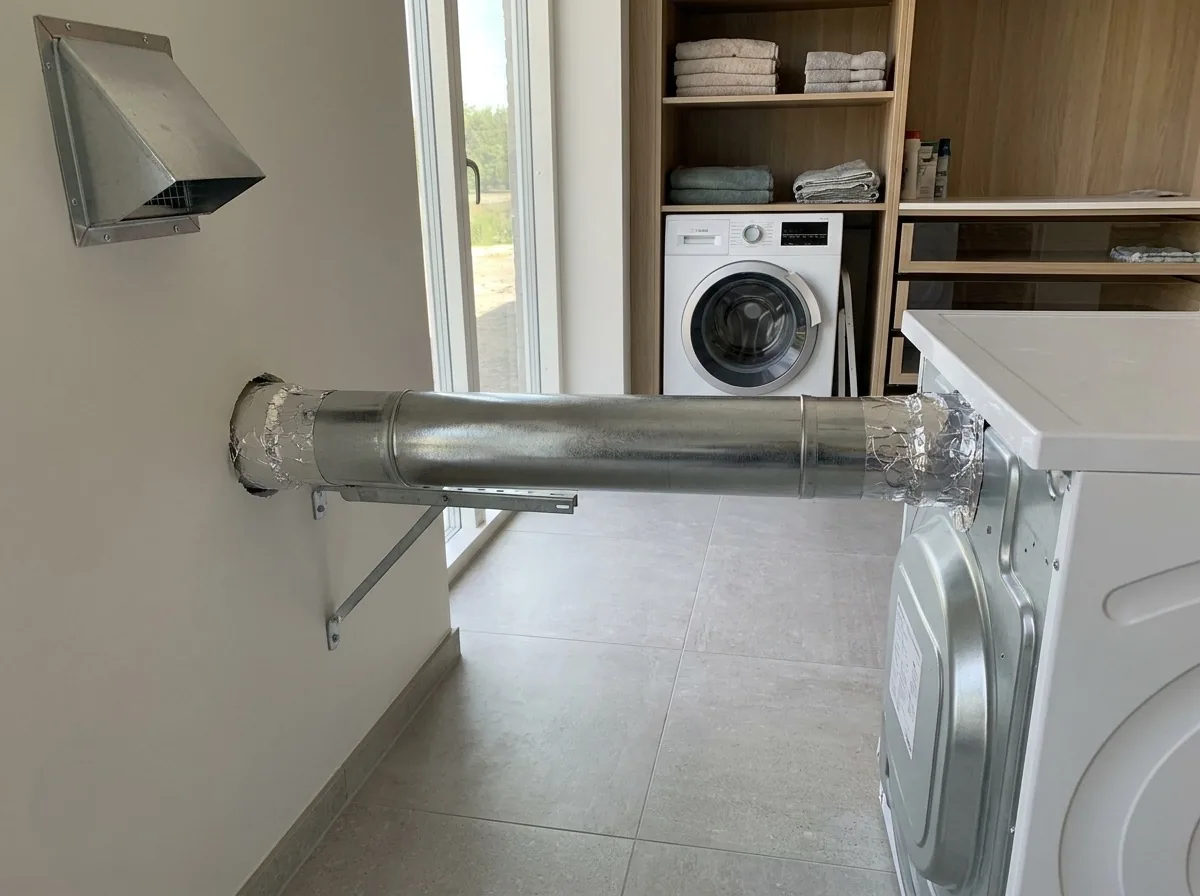
A dryer is only as safe as the duct behind it. The US Fire Administration counts about 2,900 clothes dryer fires in residential buildings each year and names failure to clean as the leading contributing factor, at 34% of them. What that statistic does not say is that a badly installed run makes the cleaning interval much shorter, because every elbow, every sag and every rough interior surface is a place lint stops moving and starts collecting.
The route is the whole job. A dryer can push its exhaust about 35 feet of equivalent length, and every 90 degree elbow subtracts roughly 5 feet from that budget. A run with four elbows has spent 20 of its 35 feet before a single straight section is counted. This is why long attic runs in wide Florida floor plans clog again within a year of being cleaned: the run was never within budget to begin with, and cleaning treats the symptom.
Four things go wrong in Florida laundry rooms more than anywhere else. Flexible plastic or foil accordion hose is used on a concealed run, where its ribbed interior catches lint and its wall can sag into a low spot. The termination is a louvered or screened cover, which is a lint trap facing the wrong way. The run is taken to the roof because no exterior wall is close, which is legal and workable but doubles the maintenance. And the transition behind the dryer is crushed flat when the machine is pushed back against the wall, which can cost more airflow than the entire rest of the run.
The humidity makes all of it worse here. A dryer works by moving moisture out of the clothes and into the air it exhausts, and ambient air that is already at 70% relative humidity gives that air less room to carry water. A Florida dryer is working harder on the same load than the same machine in a dry climate, which is exactly the condition under which a marginal duct run stops being good enough.
A correct installation is unglamorous and specific. Rigid or semi-rigid metal duct on the concealed portion, because smooth wall is what keeps lint moving. Joints assembled so the male end points downstream, in the direction of the airflow, so that lint passes the seam instead of catching on it. Joints sealed with foil tape rather than screws, because a screw head inside the duct is a snag point that builds a lint dam around itself. And the shortest practical route to an exterior wall, chosen before anything is cut.
The transition piece behind the dryer is its own item and it is the one most often wrong. It should be a listed transition duct, exposed rather than concealed, kept short, and never run through a wall or ceiling. If the dryer has to sit close to the wall, a recessed dryer vent box lets the duct turn inside the wall cavity rather than being crushed behind the machine.
The exterior termination matters more than people expect. A hooded cover with a free-swinging damper keeps rain, wind-driven water and pests out while offering nothing for lint to catch on. A screen does the opposite: it is the single most common reason a newly cleaned vent performs badly within weeks, and in Florida it is also where birds and wasps build. The damper needs to swing freely when the dryer runs and fall closed when it stops.
Where a run cannot be brought inside the length budget, the answer is either a different route or a booster fan designed for dryer exhaust, sized and installed so that it is serviceable. It is not a longer run with more elbows and a hope. A duct that cannot move the air will overheat the dryer, and an overheating dryer shortens its own life long before it ever starts a fire.
Never vent a dryer into an attic, a crawlspace, a garage or a soffit. It is not a shortcut, it is a humidity source aimed at the part of a Florida house least able to handle it, and the lint that lands with it is fuel. For a gas dryer there is a second reason: the exhaust carries combustion products, and a disconnected or indoor-terminating run puts them in the house.
Every job ends with an airflow test, because a dryer vent is one of the few home systems where the result is measurable on the spot. The number before and the number after is what tells you whether the route you paid for is doing what it was supposed to do, and it is what separates an installation from a length of duct pushed through a hole.
Key benefits
Lower fire risk
Smooth rigid metal duct on a short route gives lint nowhere to build up, which addresses the factor behind about a third of residential dryer fires.
One-cycle drying
A properly sized, sealed run restores full airflow, so clothes dry in one cycle and the dryer stops overheating itself trying.
Within the length budget
The route is planned against the roughly 35 foot equivalent length a dryer can actually push, counting 5 feet for each elbow, before anything is cut.
A termination that is not a lint trap
A hooded cover with a free-swinging damper instead of a screen, which is what keeps performance from degrading within weeks of a clean.
No moisture damage
A sealed run that terminates outdoors keeps hot, humid exhaust out of your walls and attic, where it feeds mold.
Measured, not asserted
An airflow test at the end means the new route is shown to work rather than described as working.
Our process
- Route planning. We measure the space and work out the equivalent length of each possible route, then choose the shortest practical one to an exterior wall or, when there is no other option, the roof.
- Remove what is not code. Plastic or foil accordion hose on concealed runs, screened covers and crushed sections come out rather than being worked around.
- Ducting installation. Rigid metal duct is cut and fitted with elbows kept to a minimum, with each joint assembled so the male end points downstream.
- Seal without snag points. Joints are sealed with foil tape rather than screws, because a screw head inside the duct builds a lint dam around itself.
- Transition behind the dryer. A listed transition duct, kept short and left exposed, or a recessed vent box where the machine has to sit tight to the wall.
- Exterior termination. A hooded vent cover with a free-swinging damper, and the wall or roof penetration weather-sealed properly.
- Airflow verification. A final airflow test confirms the new run moves air the way the dryer manufacturer intended, and you see the number.
Dryer Vent Installation: FAQs
Do you repair dryer vents, or only install new ones?
Both. Most of what gets called dryer vent repair is one of four jobs: replacing a crushed or foil transition hose behind the dryer, reconnecting a joint that has separated in the wall or the attic, replacing a screened or broken roof or wall cap, and rerouting a run that is over its length budget. Repair is priced inside the same $200 to $600 range as installation, and a short fix such as a new transition and cap sits at the bottom of it.
How do I know if my dryer vent needs repair rather than cleaning?
Cleaning fixes lint. Repair fixes the path. If the vent was cleaned recently and the dryer is already slow again, if you can feel warm air or see lint in the laundry room, the attic or the garage, or if the outside flap barely opens when the dryer runs, air is escaping or being blocked somewhere along the run, and cleaning alone will not hold.
How much does dryer vent installation cost in Florida?
Most installations run $200 to $600. A short wall vent sits at the low end, while rerouting a long roof run or opening walls to replace hidden ducting costs more. We quote the full price up front.
Can a dryer vent go through the roof?
Yes, roof terminations are common in Florida homes where no exterior wall is close to the laundry. They work, but the longer run traps lint faster, so plan on cleaning at least once a year.
Who installs dryer vents?
Air duct and dryer vent specialists like our team handle installation, rerouting, and repair. The work involves mechanical code, fire safety, and roof or wall penetrations, so it is not a typical handyman job.
What kind of duct is code for a dryer vent?
Rigid or semi-rigid metal duct. Flexible plastic and foil accordion hose are not code-compliant for concealed runs because they trap lint, sag, and can ignite.
How do I know my current vent needs replacing?
Plastic or foil hose anywhere in the run, clothes that need two cycles, a hot laundry room, or visible crushing behind the dryer are all signs the run should be replaced or rerouted.
How long can a dryer vent run be?
About 35 feet of equivalent length, and every 90 degree elbow subtracts roughly 5 feet from that budget. A run with four elbows has spent 20 of its 35 feet before any straight duct is counted, which is why long attic runs in wide Florida floor plans clog again within a year of being cleaned.
Why does my vent clog again so soon after cleaning?
Usually because the route is over its length budget, or because the termination is a screened or louvered cover that catches lint from the inside. Cleaning a run that was never within budget treats the symptom. Re-routing it, or replacing the cover with a hooded one that has a free-swinging damper, is what fixes it.
Can I vent my dryer into the attic or garage?
No. It is a humidity source aimed at the part of a Florida house least able to handle it, and the lint that lands with it is fuel. On a gas dryer there is a second reason: the exhaust carries combustion products, so an indoor termination puts them in the house.
Why should the joints not have screws?
A screw head inside the duct is a snag point. Lint catches on it, builds a dam around it and narrows the duct at exactly the place you cannot see. Joints are sealed with foil tape instead, and assembled with the male end pointing downstream so lint passes the seam rather than catching on it.
What is the duct behind the dryer called, and does it matter?
It is the transition duct, and it is the piece most often wrong. It should be a listed transition duct, kept short and left exposed rather than run through a wall or ceiling. Crushed flat when the dryer is pushed back, it can cost more airflow than the entire rest of the run. A recessed dryer vent box solves it where the machine has to sit tight to the wall.
Is a booster fan a good idea?
Where a route genuinely cannot be brought inside the length budget, a booster fan made for dryer exhaust, sized properly and installed where it can be serviced, is the right answer. It is not a substitute for a sensible route, and it is not a reason to accept more elbows.
Does Florida humidity affect dryer venting?
Yes, and it is underrated. A dryer works by moving moisture into the air it exhausts, and air already at 70% relative humidity has less room to carry water. The same machine works harder here on the same load, which is exactly when a marginal duct run stops being good enough.
How long does a dryer vent installation take?
One to three hours for most jobs. A short run to a nearby exterior wall is at the quick end. A reroute that involves opening a wall, or taking a new run to the roof, takes longer and we say so before booking rather than after arriving.