Air Duct Cleaning in Florida
Air duct cleaning is the professional removal of dust, debris, mold, and allergens from the supply and return ductwork of your HVAC system using negative-air (source-removal) equipment. In Florida, it is typically recommended every 3 to 5 years to protect indoor air quality and system efficiency.
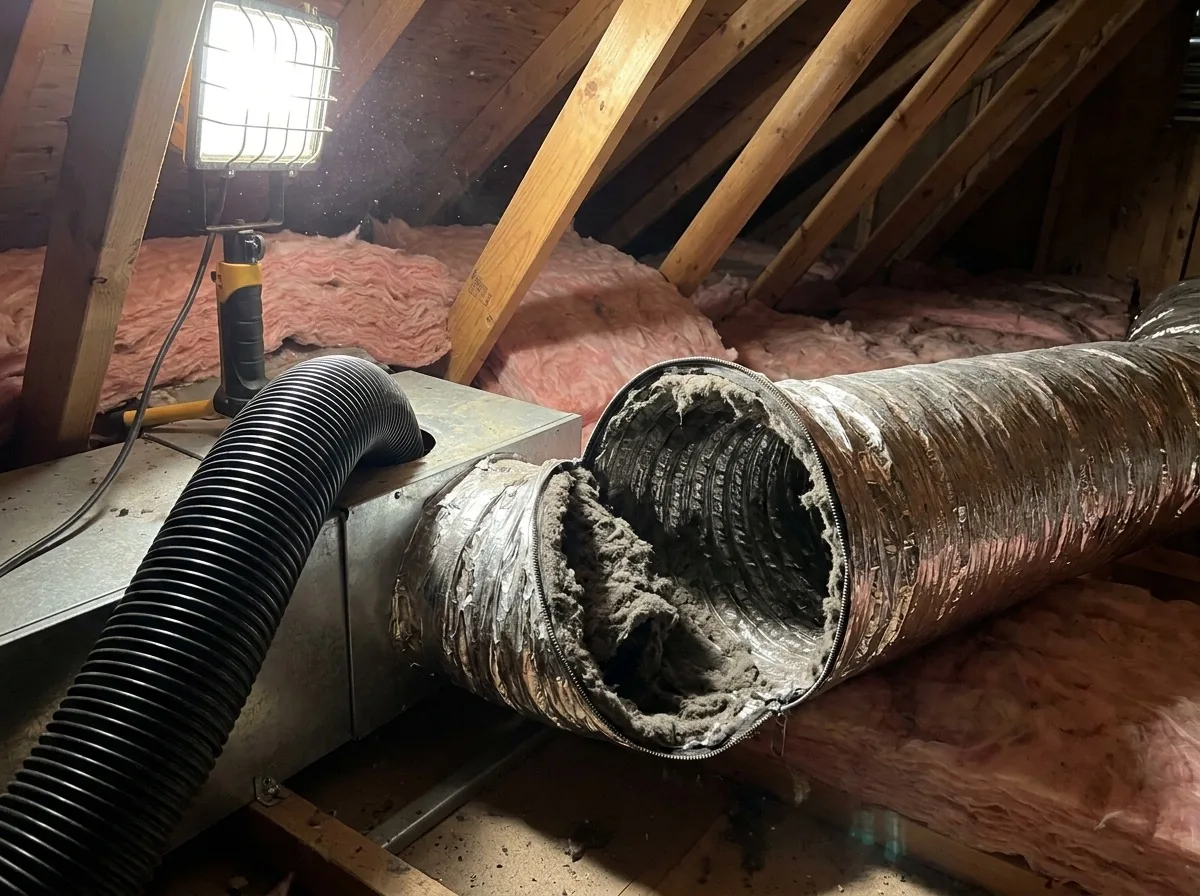
Over time, Florida's humidity, pollen, and fine construction dust settle inside your ductwork. Because the same air recirculates through your home 5 to 7 times a day, contaminated ducts continuously redistribute those particles into the rooms where your family breathes.
If you searched for AC duct cleaning, AC vent cleaning, air vent cleaning or ductwork cleaning, this is the same service. Florida homeowners usually say "AC" because almost nobody here has a furnace, so the ducts get thought of as belonging to the air conditioner. The one phrase that means something genuinely different is dryer vent cleaning, which is a separate duct and a separate job.
The work is done with a negative-air machine, either truck mounted or a portable unit we carry in. It connects to the duct system at the plenum or the main trunk and holds the whole system under continuous suction, exhausting through a HEPA filter into a sealed collection drum. That is what source removal means, and it is the method described by the NADCA ACR standard. It is a different job from a shop vacuum held at a register, which reaches the first few feet of a branch that may run twenty feet or more into the attic.
With the machine running, we seal every supply and return register in the house and open them one at a time. Sealing matters more than any tool we own. If the other registers stay open, the air takes the shortest path through them and the branch being brushed barely moves. With the rest of the system closed off, all of the airflow concentrates in the single run being worked, so debris travels to the collection unit instead of into the room.
Suction alone does not remove what has bonded to a duct wall, so each run also gets mechanical agitation. Rotary brushes on flexible shafts are used in sheet metal and duct board. Compressed-air whips and skipper balls are used in flexible duct, which has a thin liner over a spiral wire that a stiff brush can tear. The main trunk lines and the supply and return plenums are worked by hand and by rod where the machine cannot reach on its own.
The parts most often skipped are the ones that decide how your air smells. The blower wheel, the blower housing, and the accessible face of the evaporator coil sit downstream of the filter and collect a felt of fine dust that no amount of brushing inside the ducts will ever reach. In Florida those surfaces are wet for months at a time, because the coil is condensing water any time the system runs, and wet dust is where a musty startup smell begins. A visit that never opens the blower compartment is not a cleaning.
That is also why the $49 to $99 whole-house specials cannot be this service. Two technicians, a machine, and two to four hours in one house have a real cost. An advertised special at that price is either twenty minutes of vacuuming at the registers or a way through your front door, after which the number climbs. We wrote the tactic out in full, including the specific add-ons that follow, in our guide at /blog/air-duct-cleaning-scams/. Our price is $300 to $600 per system and you have it before we book.
Here is what the visit is actually like. Two technicians, two to four hours for a single-system home with roughly 8 to 14 registers, a working outlet, and a clear path from where we park to the air handler for the hose. The air handler has to be reachable, which in Florida usually means a garage, a hallway closet, or an attic platform, so that closet needs to be emptied before we arrive. Nothing heavy has to move. We ask you to pull chairs, plant stands, and storage boxes off the vents, and we handle the rest. Plan to be home at the start, to point out the rooms that smell or run dusty, and at the end for the walkthrough and the photos. The collection unit is loud, close to a shop vacuum running the entire time, so it is not a good afternoon for calls in the same room.
Most Florida homes belong on a 3 to 5 year cycle, and that is a maintenance interval rather than a health claim. The EPA is worth quoting plainly before you spend the money: duct cleaning has never been shown to actually prevent health problems, and dust levels in a home do not necessarily go up because the ducts are dirty. The EPA does recommend cleaning when one of three things is true, and we use the same three tests. Substantial visible mold growth inside the ducts or on other system components. Ducts infested with rodents or insects. Ducts so clogged with dust and debris that particles are actually being released into the room through the registers.
So there are houses we tell not to buy this. If the system was properly cleaned two years ago, nothing is visible at the registers, there is no odor and no pest evidence, and the reason you are calling is an ad, the honest answer is to wait and put the money into a better filter or a service call on the equipment. We would rather say that on the phone than take a booking that changes nothing you can notice. What we will not do is talk you out of it when there is visible mold at a supply boot or fiberglass shedding into a room, because those are real jobs.
Florida changes the work in ways a national script misses. Nearly all of the residential ductwork here is insulated flex, run through an attic that reaches 130 degrees in August, and flex sags between its supports and holds debris in the low spots. Outdoor dew points sit near 75 degrees for months, so any duct or boot with damaged insulation sweats, and that condensation lands on dust. New construction is the other common trigger: drywall sanding dust and sawdust are pulled into open returns during the build and stay in the trunk for years, which is why a two-year-old house often looks worse inside than a twenty-year-old one. Add year-round pet dander, a pollen season that never fully closes, and a house that stays sealed nine months of the year, and ducts here load faster than the same house would in a dry climate.
What the visit does not include, so nothing is a surprise. We do not repair or replace ductwork, seal leaks, or re-insulate on the same call, though we photograph anything that needs it and show you. We do not remediate mold in walls, drywall, or framing, which is separate licensed work in Florida. We do not service the refrigerant side of the equipment. We do not run laboratory air testing, so we will not make a before-and-after claim about spore counts. And if the ductwork is crushed, disconnected, or the flex liner is coming apart, cleaning it is money spent on a duct that needs replacing, and we will tell you that instead of cleaning it.
Key benefits
Cleaner air at the register
Source removal takes the dust, dander, and pollen out of the system rather than moving them around inside it. What most people notice first is the smell at startup and how much less grit shows on a white cloth held at a supply vent.
The airflow the system was designed for
A loaded blower wheel and a dusty coil face are restrictions. Clearing them lets the air handler move the volume it was sized to move, which is what shortens run times. The ducts alone rarely do that.
Less dust returning to the rooms
When the trunk, the branches, and the boots are clean, the system stops delivering a small dose of settled dust to every room each time it cycles on.
Problems found while they are still cheap
We photograph the inside of the system. Crushed flex, a boot disconnected in the attic, wet insulation at the plenum, and mold at the coil are all things you would rather see in a photo than in an August power bill.
A musty smell traced to its actual source
Most Florida AC odor comes from wet dust on the coil and inside the blower housing, not from the duct runs. Cleaning those two surfaces is what removes it. Fogging without cleaning covers it for a few weeks.
A price before we book, not after
$300 to $600 per system, quoted from the register count and the number of air handlers. Not from what a technician decides once he is standing in your hallway.
Our process
- Walkthrough and count. We count every supply and return, find the air handler, check the filter and the drain pan, and put a light and a camera into the trunk. You see the photos before any equipment comes off the truck.
- Protect the house. Drop cloths at the air handler, shoe covers inside, the collection unit staged outside or at the door, and the hose run taped down across thresholds.
- Negative-air hookup. The vacuum is connected at the plenum or the main trunk and the opening is sealed. The machine runs before any brush enters the system, so the ductwork is under suction the entire time, not part of the time.
- Seal every register. Supplies and returns are closed off so the suction cannot short-circuit through them. This is the step a rushed crew skips, and skipping it is what makes the rest of the visit cosmetic.
- Agitate and extract, run by run. One register is opened at a time. A rotary brush or an air whip is pushed the full length of that branch to the boot, and the debris travels to the collection drum. Then it is resealed and we move to the next.
- Trunk lines and plenums. The main supply and return trunks and both plenums are cleaned directly, including the corners and takeoffs where debris settles and where a duct-only cleaning stops.
- Blower compartment and coil face. The blower wheel and housing are cleaned and the accessible face of the evaporator coil is brushed and vacuumed. In Florida this is usually the dirtiest part of the system and the reason the air smells.
- Registers, grilles, and boots. Covers come off and are washed, the boots behind them are cleaned by hand, and anything rusted, loose, or missing insulation is photographed for you.
- Optional antimicrobial. An EPA-registered product, applied only after the system is clean and only when there is a reason for it, such as visible growth at the coil or plenum. Tell us at booking if anyone has asthma or a chemical sensitivity and we clean without it.
- Verify and close out. Access points sealed, a fresh filter installed if you have one on site, the system restarted with us there, then the walkthrough with before-and-after photos of the same locations.
Air Duct Cleaning: FAQs
How often should air ducts be cleaned in Florida?
Every 3 to 5 years for most homes. Sooner if you have shedding pets, a recent renovation, a new build still carrying construction dust, a mold or water history at the air handler, or someone whose allergies clearly worsen indoors. If it has been under three years and nothing is visible or smells wrong, waiting is usually the right answer.
Do I actually need air duct cleaning, or is it optional?
For most homes it is maintenance, not a repair. The EPA has stated that duct cleaning has never been shown to actually prevent health problems, and that dust levels in a home do not necessarily rise because the ducts are dirty. The EPA does recommend it in three situations: substantial visible mold inside the ducts or on system components, ducts infested by rodents or insects, and ducts clogged badly enough that debris is being released into rooms. Those are the same three tests we use.
Does air duct cleaning really improve air quality?
It physically removes the dust, dander, and mold spores that have collected inside the system, so those specific particles stop being recirculated. It does not filter the air you already have and it does not fix a humidity problem. If measurably cleaner air is the goal, your filter, your indoor humidity, and the condition of the coil matter at least as much as the duct interiors.
How long does air duct cleaning take, and how many technicians come?
Two to four hours for a typical single-system Florida home, usually with two technicians. One manages the collection unit and the trunk connection while the other works the registers one run at a time. A second system, a large house, or heavy buildup takes longer, and we say so before booking rather than rushing the back half of the job.
Do I need to be home during the cleaning?
At the start and at the end. At the start you let us in and tell us which rooms smell or run dusty. At the end we walk the house with you and show the before-and-after photos of the same locations. You do not have to sit through the middle of it.
What do you need access to, and how should I prepare?
Every supply and return register, the air handler and its closet or attic platform, an electrical outlet, and a clear path from where we park to the equipment for the hose. Please empty the air handler closet and move chairs, plant stands, and storage boxes off the vents before we arrive. That is the whole preparation list.
Is air duct cleaning messy, and how loud is it?
The system is under suction for the entire visit, so debris travels toward the machine instead of into your rooms, and we use drop cloths at the air handler and shoe covers in the house. Noise is the real disruption. The collection unit runs at roughly the volume of a shop vacuum for two to four hours, so working or napping in the same room is not realistic.
How much does air duct cleaning cost in Florida?
Most homes pay $300 to $600 for a full single-system cleaning. The price moves with the number of registers, the number of air handlers, and how much buildup is in the system. Larger homes, multiple systems, and heavy mold contamination cost more. You get the number before we book, not after we are inside.
Why do other companies advertise $99 air duct cleaning?
Because it is a lead price rather than a job price. Real source-removal cleaning takes hours of labor and real equipment, so a $49 to $99 special is either twenty minutes of vacuuming at the registers or a way to get a salesperson inside, after which the total climbs several hundred dollars. Our guide at /blog/air-duct-cleaning-scams/ lists the specific upsells to expect and the questions that end the conversation early.
What is source removal, and how do I know I got it?
Source removal means the whole duct system is held under negative pressure while each run is mechanically agitated, so the debris leaves the building instead of relocating inside it. Signs you got it: a large hose connected into the ductwork at the plenum or main trunk, every register sealed while one is worked, a brush or air whip run the full length of each branch, and an open blower compartment. Signs you did not: a household vacuum at each register and a crew finished in thirty minutes.
Do you clean the blower and the coil, or only the ducts?
The blower wheel, the blower housing, and the accessible face of the evaporator coil are part of the visit. In Florida they are usually the dirtiest components in the system and nearly always the source of a musty smell, because the coil condenses water any time the air conditioner runs.
Is AC duct cleaning the same as air duct cleaning?
Yes. AC duct cleaning, AC vent cleaning, air vent cleaning, and ductwork cleaning all describe this service. Florida homes rarely have a furnace, so people name the ducts after the air conditioner. Dryer vent cleaning is the term that means something genuinely different: a separate duct, separate equipment, and a separate price.
Will air duct cleaning lower my electric bill?
It can help when the blower wheel or the coil face was restricted, because the air handler then moves more air per minute of runtime. It is not an efficiency upgrade by itself. If the bill is the actual problem, duct leakage, attic insulation, and the condition of the equipment are usually worth more than a cleaning.
Will it get rid of the musty smell when the AC starts?
Usually, when the smell is coming from wet dust on the coil and in the blower housing, which is where most Florida AC odor starts. It will not fix a smell caused by standing water in the drain pan, a blocked condensate line, or mold in the building materials around the unit. We look for those during the inspection and tell you which one you have.
Can brushing damage flexible duct?
It can, with the wrong tool. Flex duct is a thin liner over a spiral wire, and a stiff rotary brush can tear it. We use air whips and softer agitation in flex, keep rotary brushes for sheet metal and duct board, and if a liner is already deteriorating we stop and show you rather than finish the run and hand back a torn duct.
Do you use chemicals or antimicrobial fogging?
Only when there is a reason, such as visible growth at the coil or in the plenum, and only after the system is clean. An antimicrobial sprayed into a dirty duct is cosmetic. The product is EPA-registered, and if you would rather skip it, say so at booking and we clean without it.
We just built or renovated. Should we clean the ducts now?
Yes, and it is one of the clearest cases for this service. Drywall sanding dust and sawdust get pulled into open returns during construction and sit in the trunk for years afterward. Wait until the last sanding is finished, otherwise the system simply reloads with the next phase of the work.
Does anyone need duct cleaning every year?
Almost nobody. Annual duct cleaning is an advertising schedule, not a technical one. The parts of the system that genuinely need yearly or more frequent attention are the filter, the condensate drain, and the coil in a house with pets. Duct interiors in a normal home do not reload that fast.
Do you cover my area, or do I need to bring anything to you?
The equipment travels to the house and there is nothing for you to drop off. We work across Miami-Dade, Broward and Palm Beach counties, Central Florida and Orlando, the Tampa Bay area, Southwest Florida from Fort Myers to Naples, and Jacksonville. The city list further down this page shows where we are booking, and if your town is not on it, call and ask.